
Right to Recall in India: Raghav Chadha’s Bold Proposal for Parliamentary Accountability
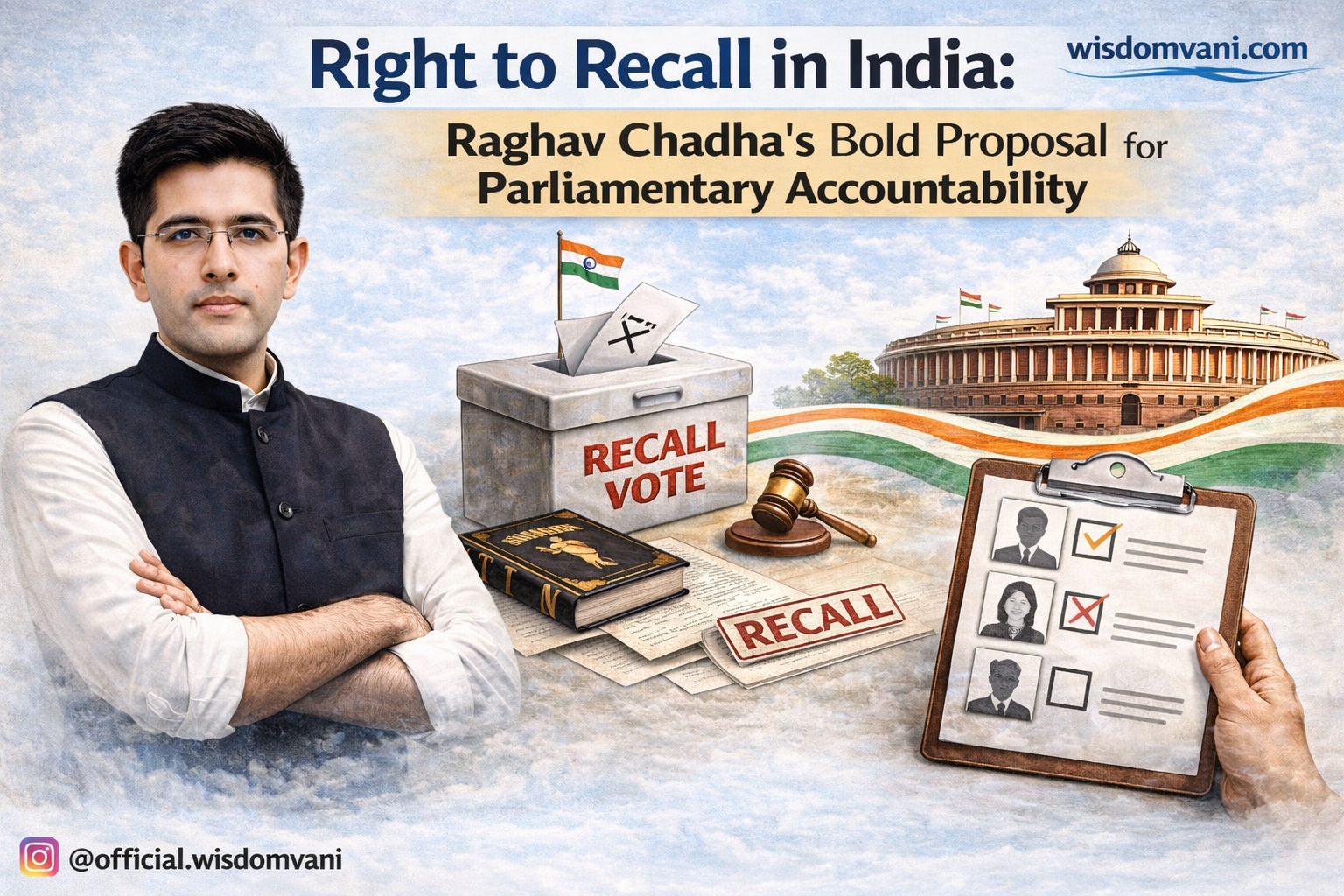
In democratic theory, the mandate given to a representative is often viewed as a "contract." When a representative fails to honor this contract, the Right to Recall acts as a legal tool for the electorate to cancel that mandate before the five-year term expires.
1. Definition and Legal Nature
Legally, the Right to Recall is a direct democratic process. It allows a specific percentage of registered voters to initiate a petition to remove an elected official. If the petition meets the legal threshold, a "Recall Election" or referendum is held. If the majority votes against the incumbent, the seat is vacated.
2. Current Legal Status in India
Currently, India’s legal framework for national and state elections does not recognize the Right to Recall:
The Representation of the People Act, 1951: This is the primary law governing elections. It only allows for the removal of an MP or MLA under specific "Disqualifications" (e.g., criminal conviction, office of profit, or insolvency). It does not allow removal for "non-performance" or "loss of public confidence."
Constitutional Silence: Articles 102 (for MPs) and 191 (for MLAs) list grounds for disqualification but remain silent on the power of the people to recall them mid-term.
3. State-Level Precedents (The "Local" Exceptions)
While absent at the national level, several Indian states have already integrated this right into their Panchayati Raj and Municipal Acts:
States: Madhya Pradesh, Chhattisgarh, Bihar, and Haryana.
Mechanism: Typically, if a certain percentage (e.g., 50%) of the Gram Sabha or ward voters sign a petition, a secret ballot is conducted to decide if the Sarpanch or Chairperson should continue.
4. Key Arguments in the Sansad (Parliament)
Raghav Chadha’s proposal in the Rajya Sabha emphasized that the current "five-year immunity" leads to a disconnect between the ruler and the ruled. His legal arguments focused on:
Substantive vs. Procedural Democracy: Moving from a system where you only participate every five years (procedural) to one where accountability is constant (substantive).
Checking Criminalization: If a representative is involved in misconduct that doesn't reach the high bar of a court conviction, the people can still act via recall.
The "De-electing" Principle: The legal logic that the power to appoint (elect) inherently includes the power to dismiss (recall).
5. Challenges to Implementation
Implementing this would require a Constitutional Amendment Bill. The legal hurdles include:
Stability of Government: Frequent recalls could lead to a "permanent election mode," draining the public exchequer and destabilizing the ruling majority.
Vexatious Petitions: There is a risk that opposition parties might use the recall mechanism to harass sitting members, leading to political instability.
The Signature Threshold: Deciding the legal "trigger point" (e.g., 25% vs 50% of signatures) is a delicate balance between public power and legislative stability.
Frequently Asked Questions (FAQs)
Q1: What is the Right to Recall as proposed by Raghav Chadha?
Ans: The Right to Recall is a democratic mechanism proposed by MP Raghav Chadha that would allow voters to remove their elected MP or MLA from office before the end of their 5-year term if they fail to perform or fulfill election promises.
Q2: Does India currently have a Right to Recall law for MPs and MLAs?
Ans: No. Currently, there is no provision in the Indian Constitution or the Representation of the People Act, 1951, that allows for the recall of Members of Parliament or State Legislatures. It would require a Constitutional Amendment to implement.
Q3: Which Indian states have implemented the Right to Recall at the local level?
Ans: Several states, including Madhya Pradesh, Chhattisgarh, Bihar, and Haryana, have legal provisions to recall representatives at the local government level, such as Sarpanches or Municipal Chairpersons.
Q4: How does the Right to Recall differ from Impeachment?
Ans: Impeachment is a process where fellow legislators or a judicial body remove an official for grave misconduct. The Right to Recall is a direct democratic action initiated and decided by the general voting public.
Q5: What are the main risks associated with the Right to Recall?
Ans: Critics argue that it could lead to political instability, frequent and expensive by-elections, and may be misused by opposition parties to harass sitting representatives. Raghav Chadha suggests safeguards like a 35-40% signature threshold to prevent such misuse.
Comments 0